
News
Students of the Nazarbayev Intellectual School in Taldykorgan entered the top of the best startups among schoolchildren in the country
25 September 2024 00:31
The republican startup competition Solve for Tomorrow has ended in Astana. This is a social project created and implemented in Kazakhstan for the fourth year in a row by Samsung Electronics. The partner is the private charitable foundation Ayala.
This year's challenge was to come up with a solution to a pressing social problem using science, technology, engineering and mathematics (STEM).
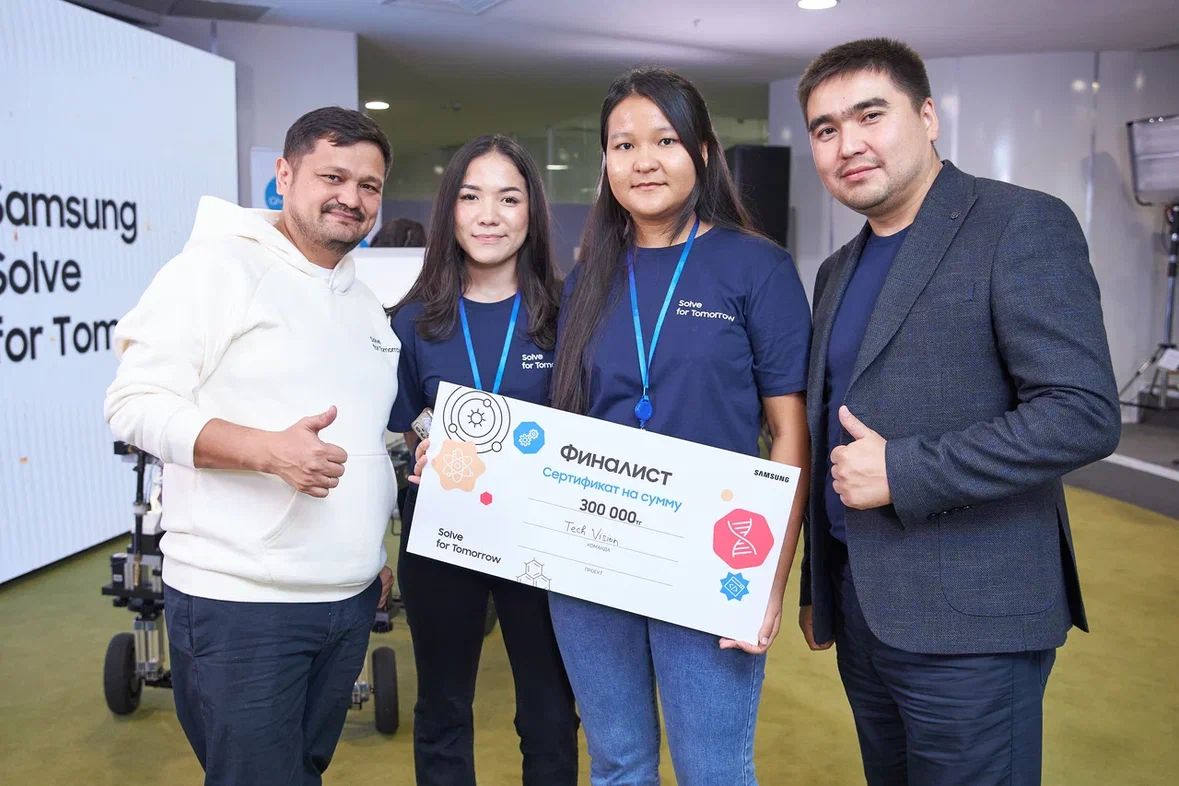
Of the 670 declared teams, 10 made it to the finals. Of which the NIS Taldykorgan team took fourth place and a certificate of 300 thousand tenge.
Anar Nurmukhan and Diana Khasimova presented three socially important startup projects. This is a pocket tactile braille tutorial, a talking traffic light for blind people and an AI VISION device - an automatic banknote recognizer.
All three projects, according to the developers, were created and tested within a year. For example, at several traffic lights in the city of Taldykorgan, voice guidance for visually impaired people is already successfully functioning. The peculiarity of the device is that voice messages are in the state language, it has the function of determining day and night, and at night it reduces the sound volume by 50%, and it is also possible to program the time interval.
The second project is a braille tutorial. The device is intended for teaching or self-studying Braille. Information is provided in the form of voice messages through the built-in loudspeaker.
The project for blind and visually impaired people was tested at a meeting with Kuanysh Kapanov, a representative of the public association “Kazakh Society of the Blind”. He considered the device unique. It is worth noting that this is the first self-instruction manual for blind people in the Zhetisu region.
The third project demonstrated at the competition was an Automatic Banknote Recognizer. It consists of a small box attached to a waist belt, with a Raspberry Pi microcomputer and AI deployed on it, and a small camera attached to the chest area.
The AI sees banknotes in hands, recognizes their denomination and names them out loud in Kazakh and Russian. The device operates completely autonomously and is rechargeable via Type C.
The current Solve for Tomorrow competition lasted more than 6 months. This year it brought together a record number of schoolchildren - over 2,500 from all over Kazakhstan.